A first visit to Dubai is easier when you check entry rules, the airport, your neighbourhood, mobile access and the journey to your hotel in advance. Here is a calm order of preparation.
Dubai can feel like a city where everything can be arranged after you land. Paying by card is easy, cars can be ordered in minutes and English is widely understood. Yet the first few hours are much calmer if you check five things before leaving home: entry rules, the airport, your neighbourhood, mobile connectivity and the route to your hotel.
You do not need to study the entire city in advance. For a first visit, it is more useful to understand your own travel scenario and have a simple arrival plan.
Begin with the purpose of the trip
Dubai stretches along the coast, and its neighbourhoods differ not only in atmosphere but also in travel time. A beach hotel, Downtown and the historic districts serve very different plans.
Before booking, answer three questions:
Are you travelling for the beach, the city, business meetings or a short stop between flights?
Will you use the metro or mainly travel by taxi?
Which two or three places genuinely matter to you?
Then look beyond the hotel photographs. Check the neighbourhood, the nearest metro station and the real distance to the places on your plan. A low room rate far from your route can turn into a daily cost in both time and money. Compare five possible bases in our carousel on where to stay in Dubai on a first visit. If the style of the stay matters as much as the district, see our selection of famous Dubai hotels for a first visit.
Check the entry rules for your passport
UAE entry rules depend on citizenship, passport type, purpose of travel and length of stay. Some visitors receive entry permission on arrival, while others need a tourist visa in advance.
Check the requirements on the official UAE Government portal and with the airline operating your flight. Confirm the required passport validity, permitted length of stay and any requirement for a return or onward ticket.
Save the following on your phone and in cloud storage:
the identity page of your passport;
your visa or evidence of your right to enter, where required;
your return or onward ticket;
your booking confirmation;
the address of your first accommodation in English;
your insurance policy and the insurer's contact details.
Copies do not replace originals, but they make it much easier to find a booking number, address or contact when needed.
Check the airport code and terminal
Your itinerary may list Dubai International, DXB, or Al Maktoum International, DWC. These are separate airports in different parts of the emirate. If the ticket takes you through Abu Dhabi, the code is AUH, and the journey to Dubai becomes a separate stage of the trip.
For terminals, connections, baggage and transport into the city, continue with our complete guide to DXB.
One day before departure, check:
DXB has metro stations at Terminal 1 and Terminal 3. Terminal 2 and DWC require different routes, so do not automatically assume that the metro will be practical. Current transport options are published by Dubai Airports and the RTA.
Prepare mobile data before departure
You will need the internet before you need any attraction: to message a driver, open an address, check a terminal or tell family that you have arrived.
If your phone supports eSIM, you can choose a UAE package in advance through the blueSIM Telegram bot. Installing the profile requires internet access, so it is more convenient to do this at home over Wi-Fi or another reliable connection.
To check eSIM support, open the phone app and dial *#06#. If the device information includes an EID number, the phone supports eSIM.
After landing, enable the correct mobile line and data roaming. If eSIM is not supported, you can buy a physical SIM card after arrival. In either case, save the hotel address and the driver's instructions so that they remain available offline.
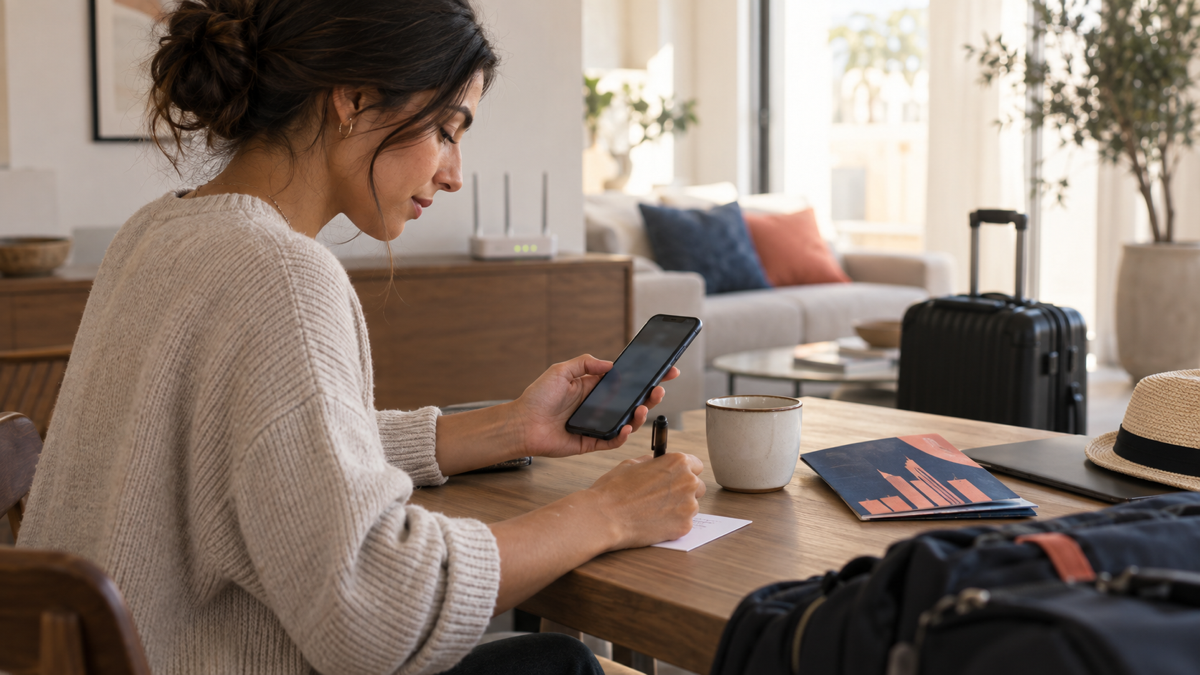
Set up connectivity and save the address before departure, while you still have stable Wi-Fi and time to check every detail.
Prepare your money without making a large airport exchange
The UAE currency is the dirham, shown as AED. Bank cards are widely accepted, although a small amount of cash is useful for minor expenses or a terminal failure.
Before travelling, check whether your card works in the UAE, which fees apply to payments and cash withdrawals, and whether transactions require confirmation in your banking app.
There is no need to exchange your entire budget at once. A card and a modest reserve are enough to begin. General currency information is available from the official Visit Dubai tourism portal.
For a practical payment and transport setup, read our guide to money, cards, language and navigation in Dubai.
Decide how you will reach the hotel
After a long flight, it helps to follow a prepared plan rather than choose your transport from scratch.
Three options work well for a first arrival:
a pre-arranged transfer;
an official taxi from the designated rank;
the metro, if you arrive at DXB Terminal 1 or Terminal 3, have manageable luggage and your hotel is convenient for a station.
Official taxis are available at the terminals around the clock and the ranks are signposted. Current information on taxis and ride-booking services is available on the Dubai Airports website.
Do not accept a ride from someone offering a car outside the official queue who cannot clearly explain the fare.
Plan for both the weather and air conditioning
Dubai is sunny for most of the year, but the summer heat significantly changes the rhythm of the day. Longer walks are better in the morning or evening, with the middle of the day reserved for indoor spaces.
Pack light clothing, sun protection and a reusable water bottle. A thin extra layer is useful too: air conditioning in the metro, malls and hotels can feel surprisingly cool.
Mosques and some cultural spaces require more modest clothing. Check the rules of each place before visiting. A seasonal temperature overview is available in the official Visit Dubai weather guide.
To understand photography, public behaviour, alcohol and medicines as well as clothing, read our practical guide to Dubai's rules without the scare stories.
Check medicines separately
If you take prescription medication, keep it in its original packaging and carry the prescription or a medical letter. Controlled medicines may be subject to separate rules, quantity limits and a declaration process.
Before departure, check the medicine in the Ministry of Health and Prevention guidance. Do not rely only on the fact that it is freely available in your home country.
What to save on your phone
passport and visa documents;
insurance details;
tickets and flight number;
airport code and terminal;
hotel address;
the driver's or accommodation's contact details;
an offline map of the area;
a backup plan for banking and mobile access.
Do not leave all of this in email alone. Create a separate folder or note that opens without internet access.
Bellboy's advice
For a first trip, do not try to understand all of Dubai in advance. Prepare only the first sequence:
entry → airport → connectivity → address → journey to the hotel.
Once these five steps are clear, the city stops looking like a complicated system. Neighbourhoods, itineraries, restaurants and entertainment can then be chosen without rushing.
When the essentials are ready, continue with a relaxed Dubai itinerary for one or two days.
Published: 17 September 2026
Reviewed and updated: 24 September 2026
Sources
Entry rules, transport, medicine requirements and commercial terms can change. Before travelling, verify the information for your passport, flight and medication with official sources.