How to pay, explain an address and plan a route in Dubai: dirhams, bank cards, nol, English, essential apps and mobile data.
People often ask whether they need cash in Dubai and whether one bank card is enough. On the ground, however, money and navigation are closely connected: you need to pay for a ride, show the driver the correct entrance, check the route and receive messages from the hotel.
A practical setup is therefore: a primary card, an independent backup payment method, a small amount of dirhams, a nol transport card and mobile internet. There is no need to turn the trip into a financial expedition; simply remove the single point of failure.
If you are at the beginning of your preparations, first read our guide to your first trip to Dubai. Here, we focus on the city's everyday mechanics.
The dirham: what you will see on prices
The UAE's official currency is the dirham. Its international code is AED, and one dirham is divided into 100 fils. Menus, apps and receipts may use other abbreviations, but when in doubt, look for the final amount in AED.
Do not try to convert every small purchase into your home currency at the counter. Save an approximate exchange rate before travelling, and check larger expenses separately. This makes errors easier to spot without holding up a queue.
Cards are the main method, but should not be the only one
Cards are convenient in hotels, malls, restaurants and most familiar visitor settings. No guide can guarantee that a particular foreign card will work at every terminal, however. A transaction may be declined because of the issuing bank, payment network, security settings or merchant.
Before departure, ask your bank:
whether the card works in the UAE;
whether international transactions must be enabled;
how currency conversion and fees are calculated;
how to reach support from abroad;
whether purchase and cash-withdrawal limits apply.
The best backup is not a second card from the same bank kept in the same wallet, but an independent payment method stored separately. If a terminal offers a choice of billing currency, do not accept automatically: inspect the rate and mark-up, then compare them with your bank's terms.
A small cash reserve is still useful
Most travellers do not need a large amount of cash. A modest reserve of dirhams is useful if a terminal is temporarily unavailable, for a small purchase or for a tip.
Do not keep the entire reserve with your primary card. Use a bank, official exchange office or ATM in a clearly identifiable location. Before confirming a withdrawal, inspect both the ATM fee and your bank's conversion terms.
Public transport uses nol
A bank card and a transport card serve different purposes. Dubai's metro, tram, buses and some marine transport use nol. You can buy the appropriate type at a ticket office or machine; check current options and conditions on the RTA website before travelling.
Make sure the card has sufficient balance before entering and tap it whenever entry and exit are required. Do not assume you can pay cash directly on board or at a gate.
The official S'hail app combines metro, tram, bus and other transport routes, provides journey information and links to nol services. If you top up nol online, verify that the balance has been credited; some top-up methods require an additional activation step.
A Dubai address is more than a street name
A district or hotel name may not be enough. A large complex can have several entrances, lobbies, towers and pick-up areas. Before leaving, save four details:
the map pin;
the full building or hotel name;
the neighbourhood;
the required entrance, tower or landmark.
Dubai's official Makani addressing system can identify an entrance precisely and is especially useful when a conventional description is ambiguous. For an everyday journey, a strong combination is a location link plus the written place name that can be shown to a driver or employee.
Do not send only a screenshot of a map. A link opens navigation, while the name confirms that both people mean the same place.
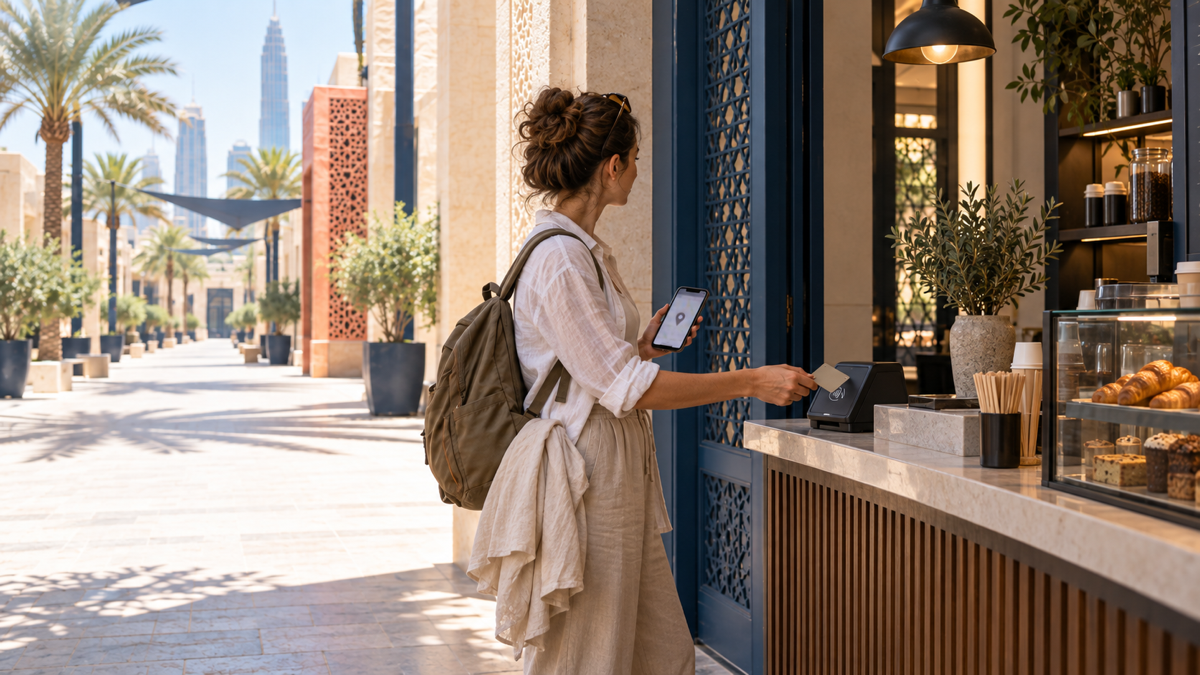
Comfortable navigation in Dubai begins with working internet, the correct entrance and a backup payment method.
English is usually sufficient
Arabic is the UAE's official language, but English is widely used in Dubai's visitor and everyday settings. At a hotel, restaurant, shop or on transport, precise information is normally more useful than a complicated sentence.
If the pronunciation of a place name is uncertain, show the address on screen. Keep the hotel name, booking number and a short entrance description available. In a noisy place, written information is more reliable than a long explanation.
A few Arabic words are a pleasant sign of respect, but learning them need not become another compulsory task. A calm greeting and a thank-you are enough to begin.
Arrange internet before leaving the airport
Mobile data is not merely for staying online. It lets you open a route, order a car, receive a message from a property, show a booking or change a meeting point.
Before departure, you can use the blueSIM Telegram bot to select a UAE package and install an eSIM. The phone needs an internet connection through Wi-Fi, active mobile service or another device's hotspot while the profile is installed.
To check whether the phone supports eSIM, dial *#06#. If an EID appears with the IMEI information, the device supports eSIM. Enable the line when needed and switch on data roaming for it; the package begins to be used after connecting to a network in the destination country.
An installed but unused blueSIM eSIM can be returned within 30 days; a purchased package can be installed and activated within 180 days. If your phone does not support eSIM, the backup is a physical SIM from a local operator after arrival.
Create a compact travel folder
Do not keep everything in a single app. Save the following on the phone or in a protected offline document:
the hotel's address and telephone number;
its location link and required entrance;
your insurance policy and support contacts;
tickets and booking confirmations;
the bank's card-blocking contact;
the route from the airport to your accommodation.
Do not include photographs showing a bank card's full number and security code. They are not needed for payment and create additional risk if the phone is lost.
Check before each outing
The phone is charged and mobile data works.
The destination opens correctly on the map.
You know the right entrance, not only the neighbourhood.
The nol card has enough balance for the route.
The primary card and small reserve are stored separately.
The time of day and weather suit a longer route.
The final point matters particularly in summer. Our guide to Dubai's weather and seasons explains when walks are better in the morning or evening and the middle of the day is best spent indoors.
Bellboy's advice
Before your first independent journey through the city, check the entire short route rather than only how you will pay:
Is the internet working? Is the pin correct? Is the entrance clear? Is nol topped up? Is the backup card stored separately?
Once these five things are ready, Dubai stops looking like a complex collection of apps and becomes an ordinary city where the next step is always clear.
Published: 17 September 2026
Reviewed and updated: 24 September 2026
Sources
Bank terms, nol top-up methods and app functions may change. Before travelling, check the current rules of your bank, the RTA and the service you plan to use.