Dubai weather changes not only what you wear but the rhythm of the trip. Here is when to plan walks, beaches, desert outings and indoor days.
People often ask for the best time to visit Dubai. There is no universal month: the right season depends on whether you want long walks, beach time, a desert trip, or short outdoor intervals between museums, restaurants and malls.
The key is to choose not only a date but a daily rhythm. The same trip can feel comfortable or exhausting depending on when you schedule walks and how much of the route is outdoors.
The short answer
November to March is generally easier for long walks, open terraces, historic neighbourhoods and desert outings.
April, May and October require a more flexible schedule. Part of the day may already be hot, so mornings and evenings are better for outdoor plans.
June to September is still possible, but the format changes. Air-conditioned spaces, short transfers and carefully timed beach visits or walks become the foundation.
This is not a forecast for specific dates. Heat, humidity, wind, dust and occasional rain all affect how conditions feel. Check the current forecast and UAE National Center of Meteorology warnings a few days before departure.
Choose the season by activity, not the calendar
If your first visit centres on historic quarters, waterfronts, souks and walking routes, the cooler season offers more freedom. You can remain outdoors longer and rely less on taxis between nearby places.
For the beach, air temperature is only one factor. Check the wind, humidity, sea conditions, available shade and the rules of the particular beach or hotel. Even in winter, an evening by the water may feel cool; in summer, the middle of the day can be too demanding for prolonged sun exposure.
Desert trips should also be judged by time of day. Morning and evening light is more comfortable for walking and photography, but temperatures after sunset may differ sharply from daytime conditions. Ask the organiser about the programme length, shade, water and appropriate clothing.
If museums, food, shopping or indoor family entertainment are the main purpose, summer does not have to be excluded. It is simply a different holiday: fewer spontaneous walks and more deliberately connected indoor routes.
In summer, change the schedule rather than fighting the city
Do not try to follow a winter routine in the hottest months. Reserve outdoor places for early morning or after sunset, and use the middle of the day for indoor spaces. Plan transport between venues even when the distance looks short on a map.
Drink water before you feel thirsty, use sun protection and do not rely on finding shade by chance. If the forecast warns of dust, strong wind or other difficult conditions, revise the plan instead of forcing it.
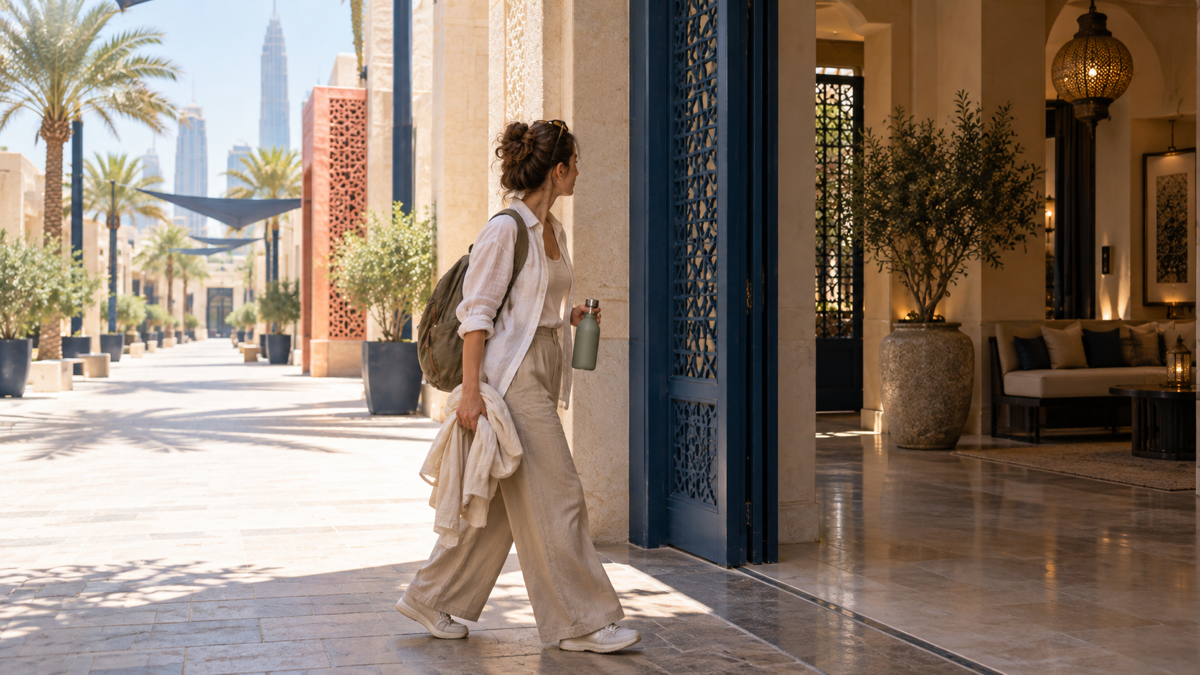
A comfortable summer route uses short transitions between the street, shade and cool indoor spaces.
Air conditioning is Dubai's second climate
It may be hot outside and cool in the metro, a mall, museum or restaurant. Even in summer, pack a light shirt, cardigan or another compact layer. It takes little space and helps with the contrast between outdoor heat and indoor cooling.
Keep it in your day bag rather than at the hotel, particularly for children and anyone sensitive to temperature changes.
What to pack
light, loose clothing in breathable fabric;
a hat and sunglasses;
comfortable city shoes;
a thin extra layer for air-conditioned spaces;
a more modest outfit for a mosque, historic site or cultural venue;
swimwear for the beach, pool or water park.
Ordinary city life does not require a special tourist uniform. Context matters: beachwear stays by the water, while religious and cultural sites may have venue-specific requirements. Our guide to Dubai's rules without the scare stories explains this principle in more detail.
What to check three to five days before travelling
The current forecast and official weather warnings.
Opening times for outdoor and seasonal venues.
Cancellation or rescheduling terms for desert, marine and other outdoor activities.
Shade and cooled areas at the beach or pool.
Dress requirements at a mosque, restaurant, club or cultural venue.
Do not build the trip around an average in a climate table. An average helps you choose the season but does not describe a particular day. For final decisions, a current forecast, warnings and venue rules matter more.
Choose your season
For a first introduction and long walks, the cooler part of the year is easier. It allows more room for mistakes in the schedule and spontaneous changes.
For a short city break, the shoulder months can work well if outdoor routes are scheduled for mornings and evenings.
For a trip built around the hotel, restaurants, museums and indoor attractions, summer can be considered once you understand its real format.
For desert outings, walking routes and long periods outdoors, choose a comfortable season first and still check the forecast for your dates.
Bellboy's advice
Do not ask only, “What will the temperature be in Dubai?” Ask a second question: “How many hours at a time do I want to spend outdoors?” That answer usually shows whether your chosen month is right.
If this is your first visit, begin with our guide to preparing for Dubai, then assign walks, beach time and indoor places to suitable parts of the day. The forecast then becomes a useful plan rather than a source of anxiety.
Published: 17 September 2026
Reviewed and updated: 24 September 2026
Sources
Climate averages do not replace a forecast for specific dates. Before travelling, check current conditions, official warnings and the rules of your chosen venues.