Dubai is calm and easy to navigate when you understand the context. Here is a practical guide to photography, clothing, alcohol, medicines, customs and online conduct.
Dubai is often presented either as a city without restrictions or as a place where a visitor risks trouble with every step. Neither extreme is useful. In practice, most situations can be understood through three ideas: place, permission and context.
If you have already read our guide to preparing for a first trip to Dubai, consider this the next level: not a list of scare stories, but a calm guide to conduct on the ground.
Do not photograph people without consent
A beautiful city photograph can easily become a dispute when a stranger is its main subject. Ask before taking a portrait, particularly a close-up or a photograph of children or a family.
Take particular care around government buildings, military facilities, airports and security zones. If security staff, an employee or a sign prohibits photography, put the camera away and ask about the rule. Malls, hotels, beach clubs and cultural venues may also impose their own conditions on professional equipment, tripods and commercial shoots.
A useful rule is that a broad city view rarely requires a difficult decision, while a person, restricted area or protected site requires permission or leaving the shot untaken.
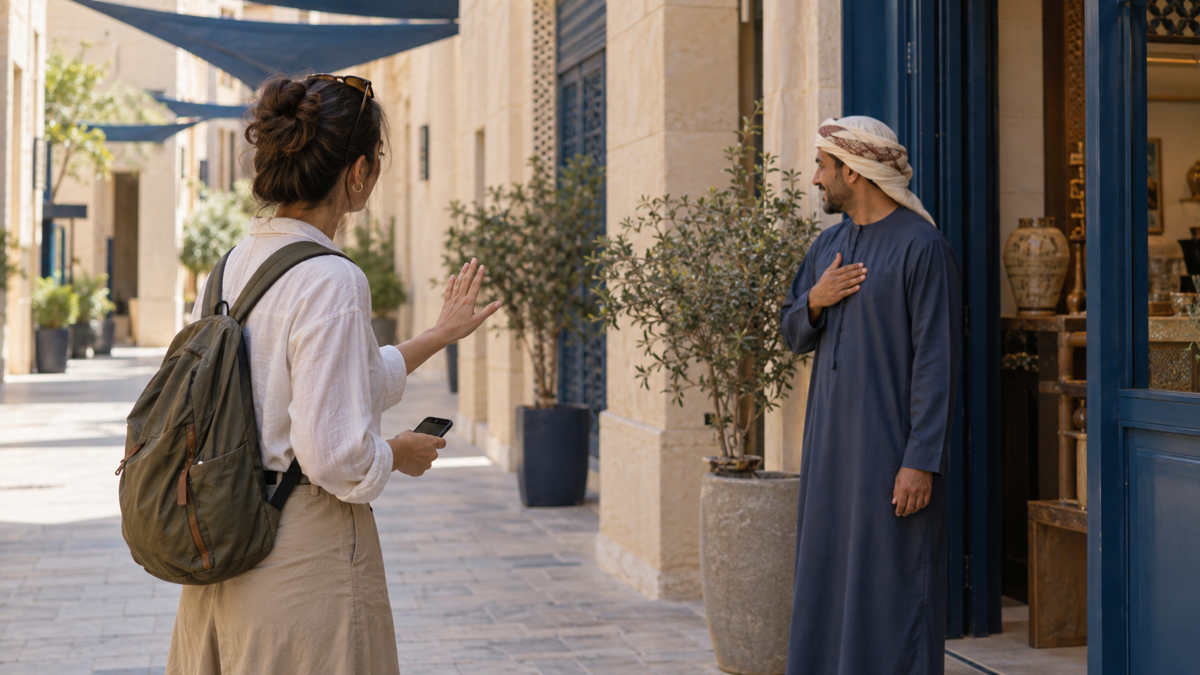
A reliable rule in Dubai is simple: if a person is the subject, ask first and photograph second.
Do not turn frustration into a public confrontation
A loud argument, abusive language or an insulting gesture can create a bigger problem than the original disagreement. If a dispute arises with a driver, shop assistant, hotel employee or another visitor, keep your voice down and avoid personal attacks.
Ask for a manager, retain the receipt or order number and explain the situation briefly. If safety is at risk, contact the official services. This is not about remaining passive; it is a more reliable way to protect your position.
Do not treat beachwear as clothing for every part of the city
Dubai is an international city, and ordinary everyday clothes do not require a special tourist uniform. Context matters.
Swimwear belongs at the beach, pool or water park.
Regular city clothing is a sensible choice for malls, business spaces and historic districts.
Mosques and certain religious or cultural sites have more specific requirements; check them before visiting.
If a member of staff asks you to cover your shoulders or adjust your clothing, this is usually a rule of that particular venue, not an invitation to debate the rules of the entire city.
Clothing also depends on the season. Our guide to Dubai's weather and the best time to visit explains the heat, air conditioning and a practical daily rhythm.
Do not confuse ordinary affection with demonstrative behaviour
Holding hands is acceptable, but official visitor guidance recommends avoiding overt displays of affection in public. Context helps here too: a quiet gesture and a provocative scene are perceived differently.
In the private spaces of a hotel, follow the property's rules. In the city, use the same restraint you would choose in a family-oriented public place.
Keep alcohol within the permitted setting
Alcohol is available in Dubai to non-Muslims aged 21 and over at licensed hotels, restaurants and venues. That does not mean it can be taken freely into every public space.
Check the venue's rules, do not enter public spaces in a condition that disturbs others, and never drive after drinking. Arrange a taxi or another sober driver for the return journey in advance.
Do not carry loose medicines without documents
A medicine sold freely in one country may be controlled in the UAE. Keep medication in its original packaging and carry a prescription or medical letter showing the medicine, dosage and length of treatment.
Before departure, check the current Ministry of Health and Prevention list and guidance. Travellers may obtain electronic pre-approval for narcotic, psychotropic and other controlled medicines. Without advance approval, these medicines must be declared on arrival together with the prescription and medical report. The quantity must match the travel period and permitted limit.
Do not search by brand name alone: the active ingredient is more important in an official list.
Do not carry someone else's luggage or conceal questionable items
Do not agree to carry a parcel or suitcase unless you have checked its contents yourself. Dubai Customs specifically advises passengers not to transport other people's luggage.
Weapons, narcotics and certain other goods are prohibited. Medicines, drones, some communications equipment, plants, animals and other items may require a permit or declaration. Cash, currencies and travellers' cheques with a combined value of AED 60,000 or more must also be declared.
If you are uncertain, check the category with Dubai Customs or use the official iDeclare service before travelling rather than attempting to explain an item during inspection.
Do not assume that an online post is a private conversation
A photograph, comment or voice message does not become harmless simply because it appears in a private account. UAE cybercrime law addresses invasion of privacy, insults, defamation and the dissemination of false information.
Do not publish another person's face, vehicle registration, document, correspondence or personal details without a clear need and consent. If describing a dispute with a company or employee, keep to verified facts, avoid speculation and use the official complaint channel first.
What to do when you are unsure
Pause before acting, rather than after someone objects.
Read the rules of the particular venue or carrier.
Ask an employee in a calm, neutral way.
Use official government sources for medicines and customs.
Do not rely on a fine table from an old post or a social-media retelling.
Bellboy's advice
Do not try to memorise dozens of prohibitions. For most everyday situations, a short check is enough:
Is this a public place? Is a person in the frame? Do I need permission? Will my action disturb anyone?
This works better than an anxious list. It helps you behave respectfully without turning an ordinary trip into an examination.
Published: 17 September 2026
Reviewed and updated: 24 September 2026
Sources
Rules, controlled-medicine lists and customs requirements can change. Before travelling, verify the current information for your medication, baggage and circumstances with official sources.