Trip planningPublished October 16, 2026· Last reviewed October 16, 2026
Hurghada in winter: choosing a hotel and what to pack
Wind and hotel facilities shape a winter beach holiday. What to ask about pools and beach access before paying, and which layers to pack.
For a winter beach holiday in Hurghada, choose your hotel around three things: conditions by the water, the specific heated pool and a short route to somewhere you can dry off and change. Sea photographs and promises of a “warm winter” do not answer those questions.
A beach holiday between November and January is possible, but it makes sense to have a backup plan for windy days. Before paying, get the hotel’s answers for your dates. Pack so that you can get dry quickly after swimming and add a warm layer in the evening.
Why one guest says “warm” and another says “cold”
Compare what people are actually describing. One person is on a sunny lounger behind a windbreak; another is coming out of the water on an exposed shore. One takes a brief dip; another swims for a long time or waits for a child beside the pool. Even at the same air temperature, these are different situations.
The Met Office explains that wind increases heat loss and the evaporation of moisture from the skin. You may therefore feel colder after a swim than before it. A dry towel and a sheltered place near the exit from the water are more useful here than arguing about who “should not feel cold”.
A review becomes more useful when you know the month, time of day, exact beach and pool, whether it was windy and the children’s ages. An October photograph and an account of a January holiday do not describe the same seasonal conditions. “We felt comfortable” helps explain someone else’s experience; it does not predict yours.
November and January have different starting points
November: mean maximum 27.0 °C; mean minimum 17.0 °C.
December: mean maximum 23.2 °C; mean minimum 13.0 °C.
January: mean maximum 21.7 °C; mean minimum 11.2 °C.
These are historical climate averages. The minimum is not the temperature every evening, and the maximum is not a temperature maintained all day. Nor are the pairs limits: individual days can be warmer or colder. The page does not give day-to-day variability, so it cannot establish the likelihood of comfortable swimming.
Sea temperature is a separate measure. Before relying on an app’s figure, check its date, location and method: an estimate for the surrounding sea does not confirm a measurement at your beach entrance. It also says nothing about a children’s pool or how you will feel in the wind after swimming. There is no single “warm enough for everyone” threshold for choosing a hotel.
Choose the actual beach, not a promise of a windless bay
A district name and the shape of a bay can help you start checking. To book, you need a plan of your hotel: the loungers, permitted swimming entrances and what lies between them and your accommodation block.
Look at which directions expose the beach to wind. Buildings, terrain or screens may shelter one area, but conditions change with the wind direction. A sheltered lounger does not mean the whole grounds and water are sheltered. Even a protected corner does not guarantee a calm sea.
Entering the water. Ask about the seabed and depth: sand, stones or coral; entry from shore or down a pier ladder. For a child or a less confident swimmer, this matters more than “private beach”.
Pier and exit. Check the length of the exposed route, steps and restrictions in rough conditions. A long walk on a pier in wet swimwear may not suit your winter plans.
After swimming. Are there windbreaks by the loungers? Where are towels available, and how close are changing facilities and an indoor space? Request recent photographs of that area, not just an aerial overview.
From the room. Check the actual route, including crossings, stairs and access through another property. “Close to the sea” does not tell you the walk from your block.
For example, Steigenberger Aqua Magic’s official description specifies that its private beach is at the neighbouring Steigenberger ALDAU Beach, separated by a promenade. For a winter booking, that is a reason to check the route from your block. A beach on the facilities list does not explain how convenient the journey is.
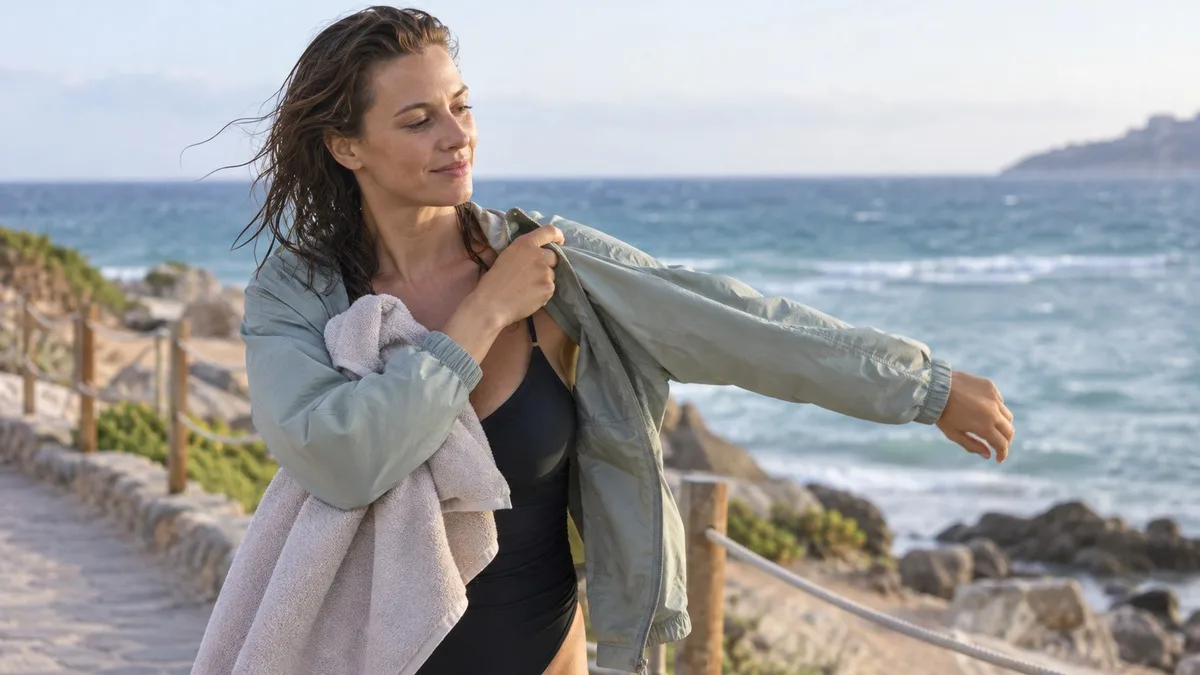
Keep dry clothes and wind protection close after swimming. AI-generated illustration; no specific hotel is shown.
Once there, assess conditions by the water and follow lifeguards’ instructions. If swimming is prohibited, do not enter simply because you paid for a beach holiday. A pool with confirmed conditions, or a day without swimming, should be a normal part of the plan.
What “heated pool” actually means
You need the name of the specific pool and its operating conditions. A large water park, several pools and a “heated” label do not establish that your chosen area will be warm and available throughout your stay.
An example near Hurghada: the official FAQ for Mövenpick Resort & Spa El Gouna lists three pools with partial heating in winter; Oasis and Lagoon have children’s pools, while the Health Club Pool is adults only. The hotel is in El Gouna, about 30 km from central Hurghada. This does not confirm heating in every children’s pool, exact seasonal dates or the temperature for your week. It is an example of reading conditions, not a recommendation to book this hotel.
Before paying, ask:
What is heated: the pool’s exact name and location. Ask separately about the children’s pool, slide area or pool by your room if you rely on them.
When: heating start and end dates, access hours and possible maintenance closures. An early November trip especially needs an answer for that week.
To what temperature: the stated operating target and how the water is monitored. If the answer is just “heated”, ask for clarification rather than assigning your own figure.
Who can use it: ages, depth, supervision rules, slide height limits and extra charges. A warm adults-only area does not replace a pool your child can use.
If things change: whether an accessible alternative is available during closures, how guests are informed and your rate’s cancellation terms.
Keep the answer with your booking conditions. A promise in an old review does not confirm operation in a new season. If heating is essential and the hotel says only “usually in winter”, factor that uncertainty into your choice before booking a non-refundable rate.
With children, check the whole short route
For a family, compare the sequence rather than the number of pools: room → suitable children’s water area → towel and dry clothes → indoor rest area. Request a plan showing your room category and distances; check steps and pushchair access.
Find out where your child can spend a windy day without swimming: an indoor play space, its hours, minimum age and whether an adult must stay. An advertised kids’ club does not mean you can leave a toddler there unaccompanied.
Keep dry clothes close to the water. If your child is uncomfortable, do not rely on someone else’s “everyone swims”. Choose a short swim according to conditions or change activities. Heating does not remove wind at the exit or the need for supervision.
What to pack
Several compatible layers are more practical than choosing between swimwear alone and heavy winter clothes. Check the forecast before departure and adjust the list to your needs.
A sunny day: light clothing, swimwear, a hat, sunglasses and your usual sun protection. Add a light long-sleeved shirt.
After swimming: a towel or beach robe, dry underwear and spare swimwear. Keep a separate dry outfit for your child near the swimming area.
Wind: a light windbreaker and comfortable long trousers. A warm top and wind protection serve different purposes; having both is useful.
Evenings: a jumper or fleece, long trousers, closed shoes and socks. For December and January, allow room to wear the windbreaker over the warm layer.
The beach: non-slip footwear for the route to the water. Ask whether water shoes are needed for your particular seabed; they do not make every spot suitable for swimming.
Check the hotel’s dinner dress code separately. A sunny daytime photograph is not a reason to expect shorts to be comfortable every evening.
How to decide before paying
If the sea matters most: look for a clear explanation of entry, an easy exit and a sheltered place to change. Accept that some days may involve no swimming.
If daily swimming matters most: check the specific heated pool and access. For families, the children’s area is crucial. Without clear confirmation, do not build the whole holiday around it.
If you want sunshine and a quiet day by the sea: choose comfortable grounds and activities without water alongside the beach. The weather will then have less influence on the whole plan.
Send a short request: “Please confirm which pool will be heated on our dates, its operating temperature and access for a child of our child’s age. We also need the route from our chosen block to the beach, the sea entrance, wind protection, closures and any extra charges.” Include dates, children’s ages and room category. Compare the answer with the cancellation terms before paying.
Bellboy’s tip: choose a hotel where you understand both the route to the sea and the next step after swimming. A short walk to a towel, dry clothes and shelter is often more useful than a general promise that “winter is warm here”.
Climate averages are not a forecast. Weather, heating schedules, beach access and children’s facilities can change. Confirm conditions with the hotel for your dates before paying; before swimming, assess current conditions and follow lifeguards’ instructions. Checked on 16 October 2026.