Your first hour in Antalya: internet, money and transport
Prepare connectivity, payment and your route before landing. A practical guide to airport Wi-Fi, lira, Antalyakart, taxis and transfers.
You leave Antalya’s terminal with your phone still offline. A calm first hour starts with three things: a saved address, a usable payment method and a route from your actual terminal to your accommodation.
Collect your bags and complete arrival formalities first, then check connectivity and your meeting point. “The first hour” is a preparation guide, not a promise to reach your hotel within 60 minutes. Queues, traffic and the distance to your resort affect the journey.
Internet: prepare a main option and a backup
Before departure, save your accommodation address in Turkish, booking confirmation, hotel contacts and an offline map. Check your home provider’s Türkiye roaming terms. A UK or EU domestic allowance does not automatically cover Türkiye, and a US international plan may require activation. Your contract, rather than the language you read, determines the charge.
If your phone supports eSIM and is carrier-unlocked, you can install blueSIM before travelling. Check Türkiye coverage, validity and when the package starts. Installation needs internet; connection after landing depends on the package, settings and network availability. Do not assume every package includes calls or text messages.
The airport website lists one hour of free Wi-Fi in all terminals and arrival and departure halls. Obtain a PIN at a Wi-Fi kiosk; the airport lists a phone, passport or identity card as access options. If registration fails, ask at the information desk and use your saved documents.
For a local SIM, compare data, validity, the full price and registration requirements. Airport purchase may be convenient, but compare the terms before paying.
IMEI: a device rule, not a visitor allowance
BTK specifies a basic 120-day period for using an imported phone without registration. This concerns the device on Turkish mobile networks, not visa-free stay. For a long visit, check IMEI status and the applicable conditions for device registration. Ask BTK about device-specific exceptions; changing a SIM is not a universal workaround.
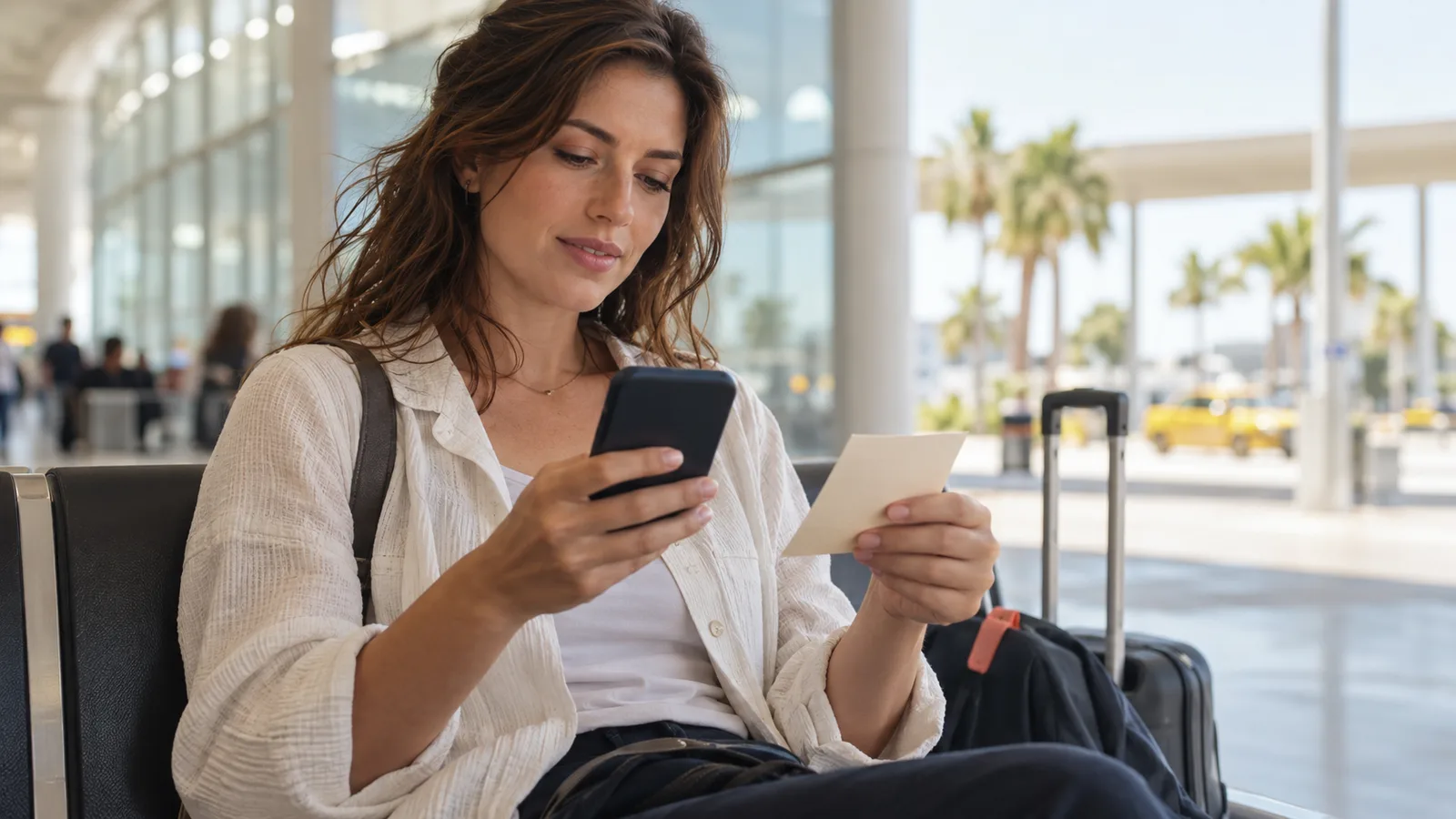
Save your address and route before leaving the terminal. AI-generated illustration.
Money: Turkish lira for initial expenses
Compare everyday prices in Turkish lira. If a merchant offers a dollar or euro price, compare the final amount and exchange rate. Foreign currency is not accepted everywhere, particularly for local transport.
Bring a usable payment method and a modest cash reserve kept separately. UK and US travellers do not have to exchange all their pounds or dollars before leaving the airport. If exchanging cash, use a bank or established exchange office, confirm which currency it accepts and check the buying rate, commission and final lira amount. Compare offers when you have time; no airport or city rate is guaranteed to be best.
Ask your issuer about international payments, ATM limits, fees and verification messages. On a terminal or ATM, compare the offer before accepting conversion into pounds or dollars. Choosing lira avoids that merchant’s or ATM’s currency conversion, though issuer charges can remain. Keep a second payment method available; acceptance depends on the card and issuer, not your citizenship.
Avoid exchanges arranged with unknown people in messaging groups. Never share a PIN or one-time banking code.
Transport: check the terminal and full destination
Confirm the actual arrival terminal with your airline and airport screens. International Terminal 1 and the domestic terminal are interconnected; Terminal 2 is separate. The airport website advertises a complimentary ring shuttle between international T1 and T2, with stops outside the departures areas. Another airport transport page also lists buses and taxis between terminals, so confirm the operating service and stop at the information desk before moving.
Do not assume the tram is outside every arrival exit. Check how to reach the stop first. A hotel in Belek, Side or Alanya is a different journey from central Antalya and may need an onward connection. Compare the entire route to your address.
Public transport and Antalyakart
The official transport page lists city buses and AntRay, including connections to central Antalya, the intercity bus station and Fatih. Check departures through Antalyakart or the Antalyakart app. Verify the last service for a late arrival rather than assuming overnight operation.
Antalyakart’s website explains Antalyakart purchase and top-up, mobile payment and contactless bank-card use. Prices and transfer rights differ: bank-card payment does not include free transfers under the FAQ rules. A foreign card must support the transaction; carry a backup. For several journeys, compare a transport card with individual bank-card payments before deciding.
Taxi or pre-booked transfer
The airport’s taxi page lists official ranks outside all terminal arrival exits, fare boards and airport identification tags for drivers. Show your exact address before getting in, confirm how the fare and payment work, and ask for a receipt.
Uber Taxi in Antalya requests a licensed local taxi. The app gives a minimum and maximum fare estimate; this is not automatically a fixed final price. Match the driver, vehicle and pickup point to the app.
If a transfer is already included in your holiday, find your operator’s representative first. For a separate booking, confirm the terminal, meeting point, flight-delay waiting policy, luggage allowance and any child seat in advance. Decline unsolicited rides from people offering an unexplained cheaper deal.
Before departure
Save your address, booking and contacts offline.
Check roaming or eSIM compatibility and activation terms.
Prepare a working payment method and some backup cash.
Confirm your terminal and the last transport service or transfer booking.
Compare the full journey with luggage, children and arrival time in mind.
Bellboy’s advice: before leaving the terminal, make sure you know the address, can pay for the journey and know where your route begins. These checks make the next step easier.