Start with a region that suits your plans. Check the season, documents, internet and payment options before your first visit.
Hello, Bellboy here. Before your first trip to Türkiye, settle three questions: which region suits your holiday, how you will pay, and what you will need as soon as you land. This is a preparation guide, without trying to fit the whole country into a week.
Türkiye brings together Antalya’s resorts, Istanbul’s ferries, Cappadocia’s valleys, Ephesus, Pamukkale, Black Sea tea plantations and the mountains of Eastern Anatolia. It spans Europe and Asia and borders four seas. Distances and climate make one region a sensible starting point.
Choose a region and a season
Beaches and resorts
On the Antalya coast, consider Antalya, Kemer, Belek, Side or Alanya. Aegean options include Bodrum, Kuşadası and Çeşme. Marmaris lies in the southwest, while Fethiye sits where the coast transitions towards the Mediterranean. These destinations do not share one uniform climate.
The beach season generally covers late spring, summer and early autumn, but water temperatures and seasonal facilities vary. July and August can be very hot. May, June, September or early October are often more comfortable for sightseeing and trips with children; check swimming conditions for your resort and dates.
Cities and nature
Spring and autumn often suit walks through Istanbul, Cappadocia, Ephesus, Pamukkale and Hierapolis, Antalya’s old quarters and Alanya’s fortress. İzmir, Bergama and Kuşadası offer a starting point for western Türkiye. Pack a waterproof jacket and closed shoes in the shoulder season.
In Istanbul, build a day around the Bosphorus, Hagia Sophia, the Blue Mosque, Topkapı or Galata Tower. Do not assume you can visit them all in one day: check distances, opening hours and access arrangements.
Winter
Istanbul can have rain, wind and snow. Cappadocia remains appealing, but balloon flights depend on the weather and may be cancelled. For skiing, consider Uludağ, Palandöken, Erciyes or Sarıkamış; check open slopes and snow before booking. December to March is a rough guide, not a guaranteed operating calendar.
Bellboy’s tip: choose one main region and leave a day flexible. A forecast and realistic travel times are more useful than promising to see everything.
Check entry documents for your nationality
Entry rules depend on citizenship, passport type and purpose. Check your category with the Turkish Ministry of Foreign Affairs. Reading this guide in English does not change who a rule applies to.
British citizens travelling on ordinary British citizen passports for tourism can visit without a visa for up to 90 days in any 180-day period. US citizens with ordinary US passports also have a visa-free allowance of up to 90 days in any 180-day period. British National (Overseas), British Subject and British Protected Person passports have different visa requirements; official passports are a separate category.
Reading in English does not determine your nationality. If you hold another passport, check the country and passport category that apply to you.
Leaving and returning does not restart the allowance. Count earlier visits within the rolling 180-day window; a fresh entry cannot restore days already used.
For British citizen passports, UK travel advice requires at least 150 days of validity from arrival and one blank page. US State Department guidance specifies six months from entry for US passports. Follow the guidance for your own passport and route.
Prepare your passport, return or onward ticket, accommodation address, booking confirmation and travel medical insurance covering the full stay and planned activities. Save document copies and the insurer’s contact details. Border officers may ask for evidence of purpose, accommodation and funds. This is neither a guarantee of admission nor a universal list for every nationality.
For a longer stay, investigate a lawful residence basis and application procedure in advance. Applying does not guarantee approval and does not replace work authorisation.
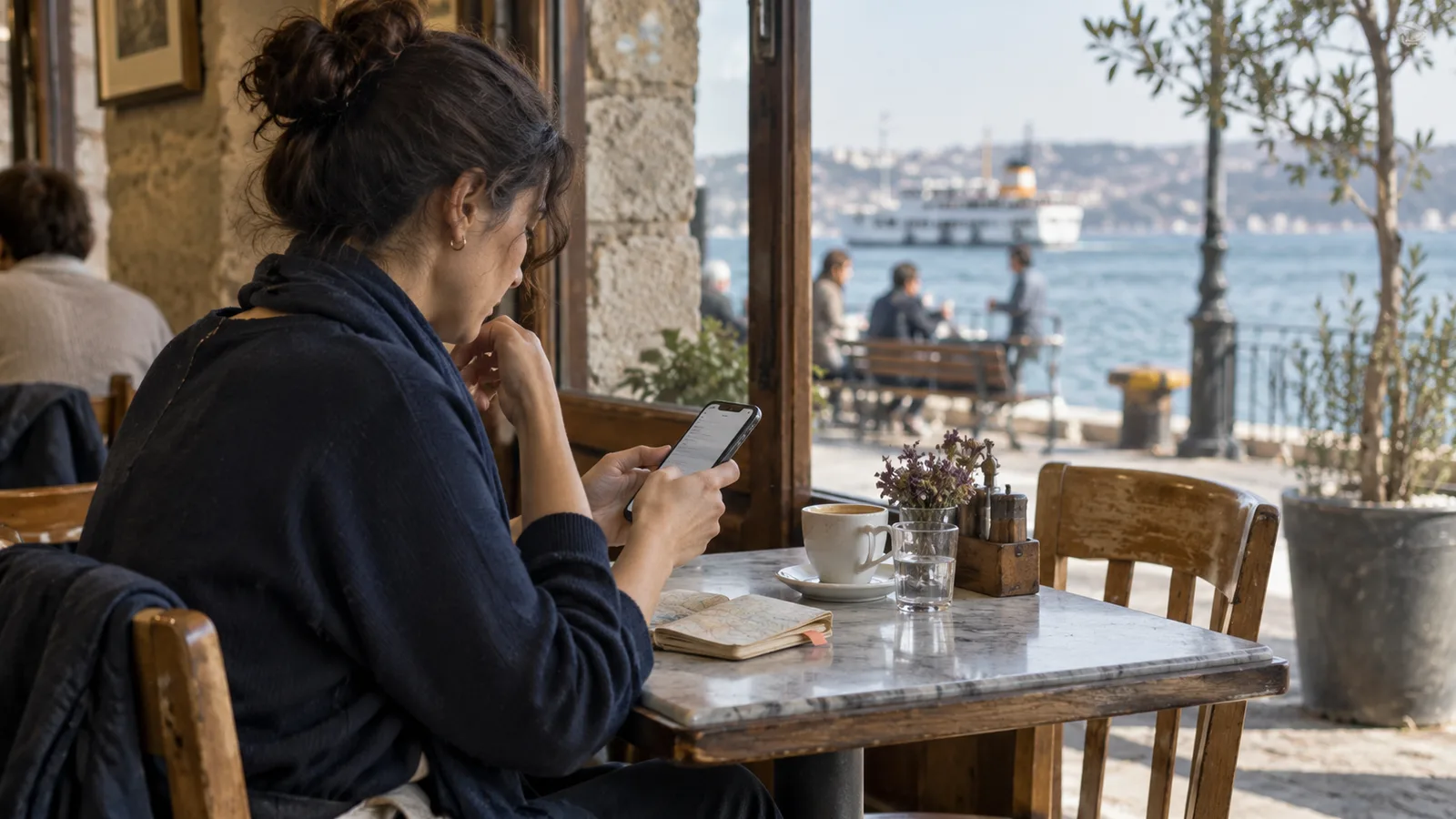
Prepare your address and first-day plan in advance. AI-generated illustration.
Arrange internet before landing
You will need connectivity for maps, your hotel address, meeting a driver, translation, banking alerts and airline messages. Airport Wi-Fi may require registration. Download an offline map and save your booking separately.
If your phone supports eSIM and is carrier-unlocked, you can install a blueSIM eSIM before travelling. Buying and installing it requires an internet connection, such as home Wi-Fi. Check Türkiye coverage, data allowance, validity, when the package starts and activation settings. No device or plan can be promised universal operation. A local operator’s physical SIM after arrival is a backup option.
For a long visit, consider IMEI registration: BTK states a basic 120-day period for using an imported phone on Turkish mobile networks without registration. Check device-specific conditions and any exceptions with BTK. This is a device rule, not a visa-free stay allowance.
Clothing and local etiquette
Dress varies widely in cities and resorts. Choose clothing that suits residential areas and religious sites. Beachwear belongs at the beach, rather than every urban setting.
Remove shoes in a mosque’s prayer hall; cover shoulders and knees, and women generally need to cover their hair. Speak quietly, silence your phone, do not walk in front of people praying and ask before photographing people. Tourist access may be restricted during prayers. Follow signs and staff instructions; scarves are not provided everywhere.
Neat everyday clothing is sufficient for an ordinary café. Check the dress code of particular restaurants and clubs in advance.
What to pack
Take comfortable shoes, a hat, sunglasses, sunscreen, light covering clothes, seasonal swimwear, a power bank and an umbrella or jacket. Carry regular medicines in their original packaging. For prescription or controlled medicines, check import rules and required documents with the authorities before travel. Do not carry other people’s medicines or packages.
Language and useful words
The official language is Turkish. English-, Russian- and German-speaking staff can be found in tourist areas, but not at every business. Save the hotel address in Turkish and an offline translator.
Merhaba — hello.
Teşekkür ederim — thank you.
Lütfen — please.
Evet / Hayır — yes / no.
Ne kadar? — how much?
Hesap, lütfen — the bill, please.
Yardım eder misiniz? — could you help?
Anlamıyorum — I do not understand.
Getting to know the food
Cooking varies by region: vegetables and olive oil in the west, fish and corn along the Black Sea, meat dishes, spices and pistachios in the southeast. Start with a few straightforward dishes.
Simit: a sesame bread ring, often eaten with tea or cheese.
Balık ekmek: fish in bread with vegetables, popular by Istanbul’s waterfront.
Dondurma: Turkish ice cream. Texture and ingredients vary; salep and sometimes mastic give it its characteristic consistency.
Baklava: thin pastry with nuts and syrup, including Gaziantep’s well-known pistachio version. Other sweets include lokum, lokma, halva, künefe, milk desserts and quince or pumpkin in syrup.
Kebap and döner: different ways of preparing and serving meat, on a plate, in bread or in flatbread.
Midye dolma: mussels with spiced rice and lemon. Check storage conditions; a queue alone does not guarantee food safety.
Gözleme: thin stuffed flatbread. Pide is boat-shaped bread with cheese, meat, vegetables or egg.
Serpme kahvaltı is a spread of small breakfast plates: cheese, olives, vegetables, eggs, jam, honey, butter, pastries and tea. Ask about portions and pricing: a set may serve two or be charged per person.
Tea usually comes in small glasses and is brewed in a double çaydanlık kettle. Turkish coffee is made in a cezve and often served with water; leave the grounds at the bottom of the cup.
Money and payments
The currency is the Turkish lira. Even when euros or dollars are accepted, compare the rate and final price. International cards are common, but small cafés, markets and some drivers may require cash. Check ATM and issuer fees before confirming a transaction.
If a terminal offers conversion into your card’s currency, compare it with your issuer’s exchange rate and fees. Paying in lira often avoids the merchant’s conversion markup, but the result depends on your card. Visa explains the right to choose the local currency.
Before travelling, ask your card issuer about overseas use, cash-withdrawal limits and fees. At the terminal, compare the exchange rate before accepting conversion into pounds or dollars; paying in Turkish lira avoids the merchant’s currency conversion, but your bank may still charge fees. Carry a second payment method and a modest cash reserve.
Prepare at least two independent payment methods and keep a reserve separately. Compare exchange rates, fees and the amount you will receive before changing cash. Even an all-inclusive holiday leaves transport, pharmacies, shopping and spending outside the hotel to consider.
Safety and help
Watch your belongings, agree the full price beforehand, keep receipts and bookings, and choose official taxis or a verified transfer. Do not leave your passport with a stranger for safekeeping or exchange money with unfamiliar individuals.
The unified emergency number is 112. Save your hotel address, insurer’s number, consular contacts and a passport copy. Ask your insurer how to arrange planned treatment; call emergency services for an immediate threat to life.
Before leaving home
Check your region, weather and travel times.
Check passport validity, entry rules and insurance.
Arrange internet, an offline map and your accommodation address.
Take a working payment method and a separate reserve.
Save emergency contacts and leave extra time on the first day.
Start with one region and a few clear tasks. That leaves room for a walk, local food and a reason to return.
Entry rules, connectivity, payments and access arrangements may change. Before travelling, check official information for your nationality, device and bank.
Audience-specific entry and payment guidance checked: 11 October 2026.
Share:
How to get there: Your first trip to Türkiye: what to prepare